
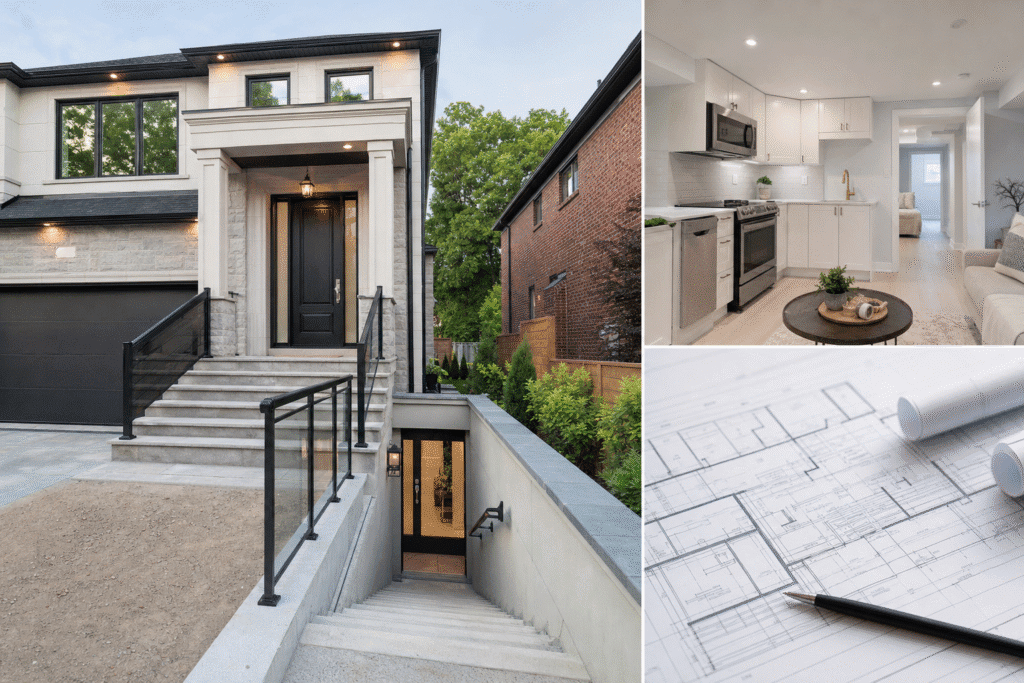
What Makes a Basement Suite Legal in Toronto: Complete Guide for Ontario Homeowners
Over 60% of basement apartments in Toronto operate illegally. That stunning statistic reveals a massive blind spot among homeowners who believe adding rental income is as simple as finishing a basement and listing it online. The reality is far more complex. A legal basement suite requires specific compliance with Ontario Building Code, municipal zoning bylaws, fire separation standards, egress requirements, and proper permitting. The difference between legal and illegal can mean insurance denial, forced tenant eviction, substantial fines, and serious liability if injury or death occurs. As licensed builders registered with HCRA and serving North York, Toronto, and across Ontario, we’ve guided hundreds of property owners through the complete legalization process at Delvin Dream Homes.
Creating a legal basement suite is not merely about following a checklist. It requires understanding how Toronto’s zoning bylaws intersect with the Ontario Building Code, how Committee of Adjustment approvals work when zoning restrictions apply, and how proper design ensures both compliance and livability. Dr. Faraz, our founder and lead architect, has navigated these regulatory waters for over a decade, transforming illegal basement rentals into fully compliant secondary suites that protect homeowners while maximizing property value. The investment in doing it right the first time pays dividends through rental income security, property insurance validity, resale value protection, and most importantly, tenant safety.
This guide breaks down every requirement that determines basement suite legality in Ontario. From minimum ceiling heights and window dimensions to fire-rated assemblies and separate utility metering, you’ll understand exactly what transforms an ordinary basement into a legal dwelling unit. Whether you’re planning a new build with a secondary suite, legalizing an existing rental, or exploring income property development, these standards apply universally across the province with specific municipal variations we’ll address throughout.
Understanding Zoning Bylaws and Permitted Use in Toronto
Zoning represents the first and most fundamental barrier to basement suite legality. Before any construction begins, you must confirm your property’s zoning designation permits a second residential unit. Toronto’s zoning bylaws vary dramatically by neighborhood, with some residential zones allowing secondary suites as-of-right while others prohibit them entirely or require minor variance approval through the Committee of Adjustment.
The City of Toronto officially permits second suites in most residential zones, but restrictions exist. Your lot must meet minimum lot area requirements, typically 185 square meters for detached homes. The property can contain a maximum of two residential units total when counting the main dwelling and basement suite. Both units must be in the same building, meaning you cannot have both a basement suite and a separate garden suite without exploring multiplex housing options under recent provincial reforms.
Provincial legislation under Bill 23 and the More Homes Built Faster Act has expanded secondary suite permissions across Ontario. As-of-right permissions now extend to up to three units on many residential lots, fundamentally changing what’s possible for homeowners and investors. However, municipal implementation varies, and Toronto maintains specific overlays, heritage districts, and neighborhood-specific restrictions that can complicate approval even under provincial permissions.
Verifying zoning compliance requires accessing your property’s specific zoning designation through the Toronto zoning bylaw map and cross-referencing permitted uses. This sounds straightforward but interpretation often requires professional expertise. At Delvin Dream Homes, we conduct comprehensive zoning analysis as part of our design services, identifying any restrictions before design work begins and developing Committee of Adjustment strategies when minor variances are necessary.
Parking requirements add another zoning layer. Toronto typically requires one parking space per dwelling unit, meaning a house with a basement suite needs two spaces total. If your property cannot accommodate the required parking, you’ll need a minor variance approval, which involves application fees, waiting periods, and no guarantee of approval. Neighbors can object, and the Committee weighs factors like neighborhood parking pressure, property layout, and precedent from similar approvals.
Front yard, side yard, and rear yard setback requirements rarely affect basement suites directly since the dwelling already exists. However, if you’re planning a new custom home with an integrated legal basement suite or adding an exterior entrance, these setbacks determine where that entrance can be located. Working with a licensed builder who understands both building code and zoning integration prevents costly redesigns when permit drawings are submitted.
Ontario Building Code Requirements for Secondary Suites
Once zoning permits a basement suite, the Ontario Building Code (OBC) establishes the physical standards that define legality. These requirements address life safety, structural integrity, fire separation, egress, ceiling heights, natural light, ventilation, and plumbing. Every single standard must be met for a basement apartment to qualify as a legal dwelling unit.
Ceiling height stands as the most common disqualifier. The OBC requires minimum 6 feet 5 inches (1.95 meters) ceiling height in habitable rooms, with allowances for beams and ducts that reduce height over limited areas. Older Toronto homes frequently feature 6-foot or shorter basement ceilings, making full legalization impossible without expensive lowering of the basement floor, a major structural undertaking requiring underpinning and foundation work. Newer homes built with suite potential typically include 7-foot or higher basement ceiling heights.
Natural light and ventilation requirements dictate window sizing and placement. Bedrooms must have windows equal to at least 5% of the floor area, with minimum openable area equal to 2.5% of floor area. A 100-square-foot bedroom needs minimum 5 square feet of glass and 2.5 square feet of openable window. Basement bedrooms face the additional challenge of window wells, which must meet minimum dimensions to provide required light and emergency egress.
Emergency egress represents a critical life safety requirement. Every bedroom requires either a door directly to exterior or a window meeting specific size and height requirements. Egress windows must have minimum 0.35 square meters (3.77 square feet) of unobstructed openable area, with no dimension less than 380mm (15 inches). The bottom of the opening cannot sit higher than 1.5 meters above the floor. Window wells serving egress windows need minimum 550mm depth from the window and clear space at the bottom for a person to stand.
Fire separation between the main dwelling and basement suite requires minimum one-hour fire-rated floor assembly. This typically means 5/8-inch Type X drywall on ceiling joists, with all penetrations for plumbing, HVAC, and electrical properly fire-stopped using approved materials. The separation extends to furnace rooms and stairs. Interconnected smoke alarms must be installed throughout both units, with carbon monoxide detectors near sleeping areas. These life safety systems cannot be compromised under any circumstances.
A separate entrance requirement applies in most jurisdictions, though not universally mandated by the OBC itself. Toronto’s bylaws typically require basement suites to have independent exterior access, preventing shared interior stairs between units. This entrance must meet step riser and tread dimensions, handrail requirements, and landing sizes specified in the building code. The entrance location must also comply with zoning setbacks and not encroach on required parking areas.
Plumbing requirements mandate that basement suites contain minimum one bathroom with toilet, sink, and bathtub or shower. A kitchen must include sink, refrigerator space, and cooking appliance connection. The building’s plumbing system must have capacity to serve additional fixtures without creating drainage or pressure issues. Many older Toronto homes require plumbing upgrades, particularly waste line sizing and venting, to properly support a legal basement suite.
Building Permit Process and Inspection Requirements
No basement suite achieves legal status without a building permit and successful inspections. The permit application process begins with detailed construction drawings showing existing conditions and proposed work. These permit drawings must demonstrate compliance with every applicable building code section, zoning requirement, and fire safety standard. As registered architects, we prepare comprehensive permit packages that address all submission requirements the first time, avoiding rejection delays that plague incomplete applications.
Toronto’s building department reviews permit applications for code compliance, structural adequacy, and coordination with zoning permissions. Review timelines vary from 4-8 weeks for straightforward applications to several months for complex projects requiring multiple consultants or Committee of Adjustment approvals. The city can request revisions, additional information, or consultant reports for structural, electrical, or mechanical systems depending on scope.
Once the permit is issued, construction proceeds under inspection oversight. Toronto requires multiple mandatory inspections at specific construction stages. For basement suite work, this typically includes foundation and structural inspections if floor lowering occurred, framing inspection before drywall installation to verify fire separations and blocking, insulation inspection, plumbing rough-in, electrical rough-in, HVAC rough-in, and final inspection verifying all systems function correctly and finishes meet code.
Each inspection must pass before proceeding to the next construction phase. Failures require corrective work and re-inspection, adding time and cost. Working with licensed builders registered with HCRA ensures that construction meets inspection standards consistently. Our team’s familiarity with inspector expectations and code interpretation prevents common failures that delay project completion.
Final inspection approval triggers issuance of an occupancy permit or final inspection clearance letter. This document confirms the basement suite meets all applicable codes and can be legally occupied. Without this clearance, the suite remains illegal regardless of construction quality. The occupancy permit should be retained permanently as proof of legal status for insurance, future sale, and tenant documentation.
Some municipalities, including Toronto, maintain a registry of legal secondary suites. Registration involves submitting proof of building permit approval, passing final inspection, and providing floor plans showing the unit layout. Registry creates a public record of legal status, which benefits resale and helps distinguish legal suites from the thousands of illegal rentals operating across the city. Dr. Faraz recommends registration for every client as standard practice regardless of whether it’s technically mandatory.
Fire Safety and Separation Standards
Fire safety requirements for basement suites go far beyond basic smoke detectors. The Ontario Building Code treats secondary suites as creating a building with multiple dwelling units, triggering enhanced fire protection standards designed to protect occupants in both the primary residence and basement apartment. Understanding these requirements separates legal suites from dangerous illegal rentals that put tenants at catastrophic risk.
The fundamental requirement is one-hour fire-rated separation between dwelling units. This fire separation must be continuous, extending across the entire floor/ceiling assembly and any shared walls. One-hour rating typically requires 5/8-inch Type X gypsum board on the basement ceiling attached to floor joists above, potentially with additional layers or resilient channel depending on the specific assembly. All penetrations through this assembly for pipes, ducts, wires, or structural members must be properly fire-stopped using approved caulking, mineral wool, or other rated materials.
Furnace rooms require special consideration when shared between units. The furnace room must maintain one-hour fire separation from both dwelling units, with self-closing fire-rated doors. Many basement suite designs locate the furnace room outside the suite boundaries, accessible only from the main dwelling, simplifying separation requirements. When the furnace room must be accessed through the suite, a separate one-hour fire-rated corridor is required, adding complexity and reducing usable space.
Stairs connecting the basement suite to upper floors, even when not used as primary access, require fire separation. If the stairs provide the only path between units and remain part of the main dwelling, they must be separated from the basement suite by one-hour fire-rated construction with a self-closing fire-rated door. This prevents fire spread between units and maintains the required separation. Many renovations install new exterior basement entrances specifically to eliminate shared stair issues.
Interconnected smoke alarms represent mandatory life safety devices. Every level of both dwelling units requires hardwired smoke alarms with battery backup, all interconnected so that alarm activation in one location triggers all alarms throughout both units. Carbon monoxide alarms must be installed outside sleeping areas in both units. These systems cannot use the same electrical circuit as general lighting to ensure they remain functional during electrical faults.
Bedroom window egress requirements serve as secondary escape routes during fire. Beyond the dimensional requirements mentioned earlier, these windows must be operable from inside without tools, keys, or special knowledge. Security bars that require keys for opening do not meet code. Window wells must have permanent ladder or steps if deeper than 600mm. The entire egress path must remain clear and unobstructed at all times, a requirement that should be incorporated into lease agreements.
Many basement suite projects at Delvin Dream Homes include upgraded fire suppression systems beyond minimum code. Sprinkler systems, though not typically required for basement suites in existing houses, provide enhanced protection that some insurance companies recognize with premium reductions. These systems also increase marketability when targeting safety-conscious tenants or during eventual property resale.
Electrical, Plumbing, and HVAC Considerations
Building systems represent significant technical and cost factors in basement suite legalization. The existing house systems must have capacity to serve additional load, or upgrades become mandatory. These upgrades often constitute the largest expense in legalization projects, particularly in older Toronto homes with outdated infrastructure.
Electrical service capacity determines whether the existing panel can support basement suite loads. A typical basement suite adds 30-60 amps of electrical load depending on size and appliances. Many older Toronto homes operate on 100-amp services that lack capacity for this additional load. Service upgrade to 200 amps involves utility company coordination, new service entrance equipment, updated main panel, and significant cost. The electrical contractor must confirm adequate capacity exists or design appropriate upgrades before permit submission.
Separate electrical metering allows landlords to bill tenants directly for electricity usage rather than including utilities in rent. While not legally required in all jurisdictions, separate metering is standard practice and often required by landlord-tenant regulations for transparency. Installing separate meters requires utility company approval, adequate service capacity, and proper metering panel installation by licensed electricians. Some municipalities mandate separate metering as a condition of basement suite approval.
Plumbing capacity issues affect both water supply and drainage. The existing water service line must deliver adequate pressure and volume to serve additional fixtures in the basement suite without degrading service to the main dwelling. Older Toronto neighborhoods sometimes operate on undersized water mains that create low-pressure conditions, requiring pressure booster systems or water service upgrades. Drainage capacity concerns focus on the building drain and sewer lateral sizing, which must accommodate additional fixture units without creating backups.
Separate plumbing metering is less common but increasingly requested by landlords for accountability. Water submeter installation allows tracking basement suite water usage separately from the main house. Unlike electrical metering, plumbing submeters are typically installed inside the building rather than at the municipal connection point, and landlords cannot bill above municipal rates. Some jurisdictions prohibit water submetering entirely, requiring flat-rate utility inclusion in rent.
HVAC systems must condition the basement suite to code-required temperatures and air quality standards. The existing furnace and air conditioning may lack capacity to adequately serve the additional square footage. Even when capacity exists, ductwork must be extended to serve basement suite rooms with proper supply and return air. Separate thermostatic control for the basement suite improves tenant comfort and energy efficiency, though not always code-required. Many basement suite projects install separate mechanical systems to ensure adequate conditioning and simplify utility billing.
Ventilation requirements under the Ontario Building Code mandate specific air change rates and kitchen/bathroom exhaust capacity. Bathrooms require exhaust fans vented directly to exterior, not into attic or basement spaces. Kitchen exhaust must vent to exterior or use recirculating range hoods meeting specific filtration standards. Heat recovery ventilators (HRVs) or energy recovery ventilators (ERVs) improve air quality in tightly sealed basement suites while minimizing energy loss, often recommended even when not explicitly code-required.
Insurance, Liability, and Financial Implications
Legal status fundamentally determines insurance coverage and liability exposure. Operating an illegal basement suite creates catastrophic financial risk that many landlords don’t fully appreciate until disaster strikes. Insurance policies for single-family homes explicitly exclude coverage for rental activities, meaning fire, water damage, or liability claims involving illegal suites will be denied, leaving the homeowner personally liable for all damages and legal judgments.
Proper insurance for properties with legal basement suites requires converting to a two-unit residential rental policy or similar coverage acknowledging the rental use. These policies cost more than standard homeowner insurance but provide essential protection for both dwelling units, liability coverage for tenant injuries, and coverage for rental income loss if the property becomes uninhabitable. Insurance companies verify legal status by requesting building permits, occupancy permits, or municipal registration documentation before issuing coverage.
Liability risk extends beyond property damage. If tenants or their guests suffer injury in an illegal basement suite, particularly due to code violations like inadequate egress, missing smoke alarms, or structural deficiencies, the landlord faces personal injury lawsuits without insurance defense or indemnification. Wrongful death claims from basement fires have resulted in multi-million dollar judgments against homeowners who operated illegal suites. No amount of rental income justifies this catastrophic exposure.
The financial investment in legalization typically ranges from $50,000 to $150,000 depending on existing conditions and required upgrades. This includes design and permit fees, structural work, systems upgrades, fire separations, new entrance construction, finishes, and contractor labor. Properties requiring extensive work like floor lowering, service upgrades, or foundation repairs fall at the higher end. However, this investment creates substantial value through legal rental income, increased property value, and risk elimination.
Rental income from legal basement suites in Toronto typically generates $1,800 to $2,800 monthly depending on size, finishes, and location. Annual gross rental income of $25,000 to $35,000 provides strong return on legalization investment, usually achieving payback within 3-5 years. Beyond cash flow, legal suites increase property market value, with many buyers specifically seeking properties with legitimate income potential. Appraisers recognize legal suite value while heavily discounting or ignoring illegal rentals.
Tax implications require careful consideration. Rental income must be reported to CRA, with deductible expenses including mortgage interest proportionate to rental square footage, property taxes, insurance, utilities, repairs, and depreciation. Legal suites operated as long-term rentals generally don’t affect principal residence exemption on capital gains, though professional tax advice is essential. The key distinction is that legal suites provide documentable, defensible rental income while illegal operations create tax audit risk and potential penalties for unreported income.
Working with Licensed Professionals and HCRA Builders
Basement suite legalization demands professional expertise across architecture, engineering, building code interpretation, zoning analysis, and construction execution. Homeowners attempting DIY legalization or hiring unlicensed contractors consistently encounter permit rejections, failed inspections, cost overruns, and work that ultimately doesn’t achieve legal status despite substantial investment. The complexity of coordinating building code, zoning bylaws, fire safety standards, and municipal processes requires integrated expertise that only experienced professionals provide.
Licensed architects and designers bring essential value in space planning that maximizes usable area while meeting all dimensional requirements. Dr. Faraz’s approach at Delvin Dream Homes integrates code compliance from initial concept rather than attempting to force compliance onto a design after the fact. This proactive methodology identifies issues like inadequate ceiling height, insufficient egress, or problematic fire separations before construction begins, when solutions are least expensive to implement.
Choosing HCRA-registered builders provides critical homeowner protections. The Home Construction Regulatory Authority (HCRA) requires builder licensing, financial accountability, and adherence to professional standards. HCRA registration is mandatory for new home construction in Ontario and provides access to Tarion warranty protection covering defects and structural issues. While basement suite renovations in existing homes don’t always trigger Tarion warranty requirements, working with HCRA-registered builders like Delvin Dream Homes ensures professional standards and recourse if issues arise.
Tarion warranty coverage, when applicable, protects homeowners through one-year warranty on materials and labor, two-year warranty on water penetration, electrical, plumbing, and HVAC systems, and seven-year warranty on structural defects. This protection proves invaluable if foundation work, structural modifications, or building envelope changes are required for basement suite legalization. The warranty transfers to subsequent property owners, adding marketability and buyer confidence during resale.
End-to-end project management from concept through final inspection streamlines the complex approval and construction process. Our approach at Delvin Dream Homes coordinates architectural design, engineering consultants, permit applications, Committee of Adjustment appearances when required, construction scheduling, trades coordination, inspection bookings, and final occupancy permit acquisition. This integrated service model prevents gaps and miscommunication that plague projects using disconnected designers, permit services, and contractors.
Committee of Adjustment expertise becomes essential when minor variances are required for parking, setbacks, or other zoning provisions. Successful variance applications require understanding precedent decisions, neighborhood context, planning justification, and presentation strategy. Dr. Faraz has guided numerous variance applications through approval, securing permissions that enable otherwise impossible projects. This specialized knowledge distinguishes experienced professionals from general contractors lacking municipal approvals expertise.
Cost transparency throughout the process prevents budget surprises. Detailed estimates covering design fees, permit costs, structural engineering, municipal application fees, construction costs broken down by trade, contingencies, and timeline expectations allow informed decision-making before commitments. Hidden costs in basement suite projects typically emerge from unanticipated structural issues, inadequate existing systems requiring upgrade, or permit requirement changes. Experienced professionals identify these risks during initial assessment, providing realistic budgets that rarely face significant overruns.
Frequently Asked Questions
Can I legalize a basement suite that’s already rented out?
Yes, existing illegal basement suites can be legalized, but tenants must typically vacate during construction to allow permit inspections and renovation work. The process involves obtaining building permits for code upgrades, completing required construction under inspection oversight, and passing final inspection before re-occupancy. Many municipalities offer amnesty programs encouraging legalization of existing rentals without penalties for prior illegal operation, though policies vary. Tenant relocation during construction presents challenges, but establishing legal status protects both landlord and tenant long-term. Consult with professionals experienced in occupied building renovations to minimize disruption and coordinate temporary housing if the existing tenant relationship will continue.
How much does it cost to create a legal basement suite in Toronto?
Legalization costs range dramatically from $50,000 to $150,000 or more depending on existing conditions and required upgrades. Properties with adequate ceiling height, recent electrical and plumbing systems, and good drainage fall toward the lower end, requiring primarily fire separations, separate entrance, finishes, and permit fees. Homes needing floor lowering, electrical service upgrade, foundation waterproofing, or extensive systems work reach higher costs. Design and permit fees typically represent 10-15% of total project cost. Detailed assessment of existing conditions provides accurate budgeting. Request a comprehensive evaluation from licensed professionals before proceeding to understand full financial commitment.
What’s the difference between a legal basement apartment and a second suite?
The terms are often used interchangeably, both referring to self-contained dwelling units subordinate to the primary residence. “Second suite” is the official term in many Ontario municipal bylaws and provincial legislation, emphasizing that the unit is secondary to the main dwelling. “Basement apartment” describes location but may not always be fully self-contained. Legal status requires the same standards regardless of terminology: compliance with zoning permissions, building code requirements including separate entrance, full kitchen and bathroom, adequate ceiling height and egress, proper fire separations, building permits, and passed inspections. The key distinction is legal versus illegal operation, not naming convention.
Do I need separate utilities for a legal basement suite?
Separate electrical metering is standard practice and required in many jurisdictions, allowing tenants to pay their own electricity costs. Separate water metering is less common and sometimes prohibited by municipal bylaws. Gas metering separation is rarely implemented due to technical complexity and cost. While not universally code-required, separate utilities provide billing transparency, reduce landlord-tenant disputes, and incentivize tenant energy conservation. Some municipalities mandate separate electrical metering as a condition of secondary suite approval. Even where not required, separate metering is recommended best practice. Heat inclusion in rent or separate billing through submeters depends on HVAC system configuration and local regulations.
Will a legal basement suite increase my property taxes?
Adding a legal basement suite typically triggers property tax reassessment since the property now contains two dwelling units instead of one. Tax increase depends on how the municipality classifies and taxes multi-unit residential properties. In Toronto, properties with legal second suites are assessed at residential rates but reflect increased property value from rental income potential. The tax increase is generally modest compared to rental income generated, and the assessment reflects market reality that properties with legal income suites command premium pricing. Illegal suites create tax risk if discovered, potentially triggering retroactive reassessment and penalties. Legal status provides predictable, defensible tax treatment.
Making Your Basement Suite Legal the Right Way
The difference between legal and illegal basement suites ultimately comes down to professional execution of regulatory requirements and building standards. Cutting corners on permits, ignoring fire separations, or failing to meet egress requirements creates liability time bombs that jeopardize tenant safety, void insurance coverage, and expose homeowners to devastating financial consequences. Legal status requires investment, patience through the approval process, and commitment to doing things correctly, but the protection and value created justify every dollar and every delay.
At Delvin Dream Homes, we’ve guided countless North York and Toronto homeowners through basement suite legalization from initial zoning analysis through final occupancy permit. Dr. Faraz and our team of licensed professionals understand the technical requirements, municipal processes, and construction execution necessary to create basement suites that meet all legal standards while maximizing livability and rental value. Our end-to-end approach coordinates every aspect of the project, ensuring nothing falls through the cracks between design, permits, construction, and approval. If you’re ready to explore basement suite potential for your property, request a consultation to discuss your specific situation, review feasibility, and develop a clear path to legal, profitable rental income. Call (647) 994-6010 or visit us at 105 Harrison Garden Boulevard in North York to start the conversation about transforming your basement into a legal, valuable income-generating asset.
