
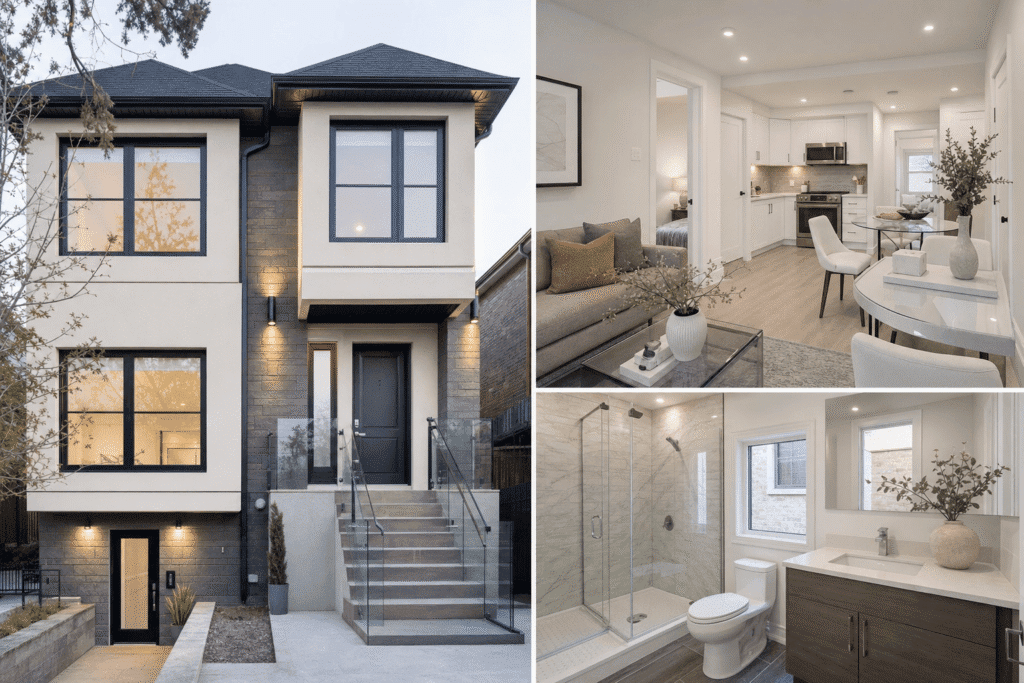
Most Toronto homeowners don’t realize that adding a second suite without proper permits can result in fines up to $50,000 and forced removal of the unit. The City of Toronto takes Additional Residential Units (ARUs) seriously, and the legalization process involves far more than just finishing a basement or converting an attic. Understanding how to add a legal second suite requires navigating Ontario Building Code requirements, municipal zoning bylaws, fire separation standards, and permit approvals.
The good news? Ontario’s housing reforms have made it easier than ever to create legal rental income from your property. But the rules are specific. You need accurate drawings, fire-rated assemblies, separate HVAC systems, egress windows, and full municipal sign-off. Miss one detail and your suite remains illegal, uninsurable, and potentially dangerous.
This guide walks you through every step of the process, from initial feasibility assessment to final occupancy permit. We’ll cover what makes a second suite legal in Toronto, the design requirements you must meet, and how to work with the City to ensure full compliance. Whether you’re planning a basement apartment, a second-floor conversion, or an entirely new build with multiple units, you’ll understand exactly what it takes to do it right.
What Defines a Legal Second Suite in Ontario
A legal second suite is an Additional Residential Unit (ARU) that meets all Ontario Building Code requirements and has been approved by your local municipality. It’s not just about having a kitchen, bathroom, and bedroom. The suite must have independent life safety systems, proper fire separation, adequate ceiling height, natural light, ventilation, and emergency egress.
In Toronto and across Ontario, a legal second suite also requires a building permit, electrical permit, plumbing permit, and HVAC permit. You’ll need stamped architectural drawings that show compliance with all applicable codes. The City inspects at multiple stages: framing, insulation, mechanical rough-in, and final occupancy.
The term “second suite” typically refers to a self-contained unit within an existing dwelling. This could be a basement apartment, a second-floor unit, or a converted garage space. It’s different from a multiplex or garden suite, which are separate structures or newly built multi-unit buildings.
At Delvin Dream Homes, we design and permit second suites throughout North York and Toronto. Dr. Faraz works directly with homeowners to ensure every detail meets both Ontario Building Code standards and local zoning requirements before construction begins.
Zoning and Municipal Requirements for Second Suites in Toronto
Before you design anything, verify your property’s zoning allows a second suite. Most residential zones in Toronto permit one Additional Residential Unit as-of-right, but there are exceptions. Some heritage districts, certain RD zones, and properties with existing legal non-conforming uses may have restrictions.
You’ll also need to meet lot coverage, setback, and parking requirements. Toronto’s zoning bylaw doesn’t require additional parking for a second suite in most cases, but you must verify this with your specific property. If your home is on a narrow lot or in a parking permit area, the rules can differ.
The City of Toronto requires a building permit application that includes detailed architectural drawings, structural plans if walls are being moved, mechanical and electrical plans, and a site plan showing existing conditions. These aren’t simple sketches. They need to be prepared by a qualified designer or architect who understands municipal submission standards.
Dr. Faraz manages the full permit process at Delvin Dream Homes, including Committee of Adjustment submissions when minor variances are required. We’ve worked on hundreds of second suite projects in North York, and we know exactly what the City looks for in a complete application. One missing detail can delay your permit by weeks.
Expert Tip from Delvin Dream Homes
Always order an as-built measurement before starting design work. Toronto inspectors will compare your permit drawings to actual conditions during inspections. Any discrepancies can trigger stop-work orders or failed inspections.
Ontario Building Code Requirements for Second Suite Design
The Ontario Building Code sets strict standards for second suites. Ceiling height must be at least 1.95 meters (6 feet 5 inches) for habitable rooms, with full 2.3 meters (7 feet 6 inches) in bedrooms and living areas recommended for comfort. Basement suites require at least 50% of the required window area to be above grade.
Fire separation is non-negotiable. The suite must be separated from the primary dwelling by a fire-rated assembly, typically 1-hour fire resistance. This means Type X drywall on both sides of separating walls and ceilings, with proper fire-stopping at all penetrations. You can’t just throw up standard drywall and call it done.
Every bedroom must have an emergency egress window with a minimum opening of 0.35 square meters and no dimension less than 380 mm. The window sill can’t be more than 1.5 meters above the floor. Basement bedrooms often require window wells with proper drainage to meet this standard.
Mechanical systems must be independent or properly designed to serve both units without cross-contamination. You’ll need separate heating controls, return air pathways, and often separate HVAC equipment. Plumbing must meet Ontario Plumbing Code standards, with proper venting and drainage for all fixtures.
At Delvin Dream Homes, we prepare full second suite design and permit plans that address every code requirement. Our drawings include detailed fire separation notes, egress window schedules, and mechanical layouts that inspectors can review without questions.
Fire Safety and Life Safety Systems for Legal Suites
Fire safety is the most critical aspect of a legal second suite. You need interconnected smoke alarms on every level, inside each bedroom, and outside sleeping areas. In most cases, hard-wired alarms with battery backup are required. Carbon monoxide detectors must be installed if there’s a fuel-burning appliance or attached garage.
The suite must have a separate exit to the exterior. This could be a dedicated doorway, or in some cases, a compliant egress window in a basement suite. The exit path must be clear, unobstructed, and properly lit. Stairways serving the suite need to meet dimensional requirements: minimum 860 mm width, maximum 200 mm riser height, minimum 210 mm tread depth.
Fire-rated doors are required where the suite connects to shared areas like furnace rooms or common hallways. These doors must be self-closing with proper fire-rated hardware. You can’t use a standard residential door from Home Depot. It needs to be a certified fire door with the appropriate label.
In projects where fire separation between units becomes complex, especially in older homes with irregular layouts, Delvin Dream Homes often coordinates with structural engineers to design compliant assemblies that don’t compromise the home’s character or usability. Dr. Faraz has extensive experience with fire separation requirements in Toronto’s diverse housing stock.
DELVIN DREAM HOMES
Ready to build your dream home?
Get a free consultation with Dr. Faraz and our expert team to discuss your project vision, budget, and timeline.
The Permit Application and Approval Process
Applying for a second suite permit in Toronto involves submitting a complete application package to the City’s Building Division. This includes architectural drawings, structural plans if required, mechanical and electrical plans, a site plan, and the applicable fees. Permit fees for a typical second suite range from $3,000 to $8,000 depending on the scope of work.
The City reviews your application for code compliance, zoning conformity, and completeness. Initial review typically takes 4 to 8 weeks, though more complex applications can take longer. The City may issue a preliminary review letter requesting revisions or clarifications. You’ll need to respond with updated drawings before the permit is issued.
Once the permit is issued, you can begin construction. But you’ll need to schedule inspections at key milestones: after framing and before drywall, after rough-in mechanical and electrical, after insulation, and for final occupancy. Each inspection must pass before you proceed to the next stage. Failing an inspection means correcting deficiencies and booking a re-inspection.
The final step is obtaining an occupancy permit or a final inspection sign-off. This confirms the suite meets all code requirements and is safe for habitation. Without this, your suite remains illegal, regardless of how well it’s built. Insurance companies won’t cover illegal suites, and you can’t legally rent the space.
Delvin Dream Homes manages the entire permit and inspection process for our clients. We coordinate with City inspectors, respond to review comments, and ensure every stage passes on the first inspection. Our track record as a licensed HCRA builder gives us direct accountability for code compliance.
Expert Tip from Delvin Dream Homes
Schedule your rough-in inspection before installing insulation, even if you think everything is correct. Inspectors often catch minor issues early that are easy to fix. Correcting them after drywall goes up costs ten times more in labor and materials.
Common Design Challenges and How to Solve Them
Low ceiling heights in basements are the most common obstacle. If your basement has 6-foot ceilings, you’ll struggle to meet code minimums. Solutions include lowering the floor (expensive and structurally complex), raising the main floor (rarely feasible), or accepting reduced usable space by avoiding low areas.
Inadequate natural light and egress windows also stop many projects. Basement windows are often too small or too high to meet code. You’ll need to install larger windows, which may require cutting foundation walls, installing window wells, and waterproofing the openings. This isn’t a DIY project.
Insufficient parking can trigger zoning issues in some Toronto neighborhoods. While most second suites don’t require additional parking, if your property is in a zone with parking minimums or a permit parking area, you may need to demonstrate compliance or apply for a minor variance through the Committee of Adjustment.
HVAC capacity is another frequent problem. Your existing furnace and air conditioning may not have enough capacity to serve two separate units. Upgrading mechanical systems adds significant cost, but it’s essential for comfort and code compliance. Skimping here results in uncomfortable tenants and potential equipment failure.
At Delvin Dream Homes, we identify these challenges during the initial site assessment. Dr. Faraz personally reviews every property before providing a quote, so there are no surprises halfway through construction. We’ve solved design challenges on properties across North York, from post-war bungalows to 1920s two-storeys.
Costs, Timelines, and Return on Investment
Creating a legal second suite in Toronto typically costs between $60,000 and $120,000, depending on the scope of work. A simple basement conversion with minimal structural changes sits at the lower end. Adding exterior access, upgrading mechanical systems, or dealing with low ceilings pushes costs higher. Custom finishes and high-end appliances add more.
Timelines vary based on permit approval and construction complexity. Expect 2 to 3 months for permit approval if your application is complete and code-compliant. Construction takes another 3 to 5 months for a typical basement suite. So you’re looking at 6 to 8 months from initial design to final occupancy permit.
The return on investment is strong. A legal second suite in Toronto can generate $1,800 to $2,800 per month in rental income, depending on location, size, and finishes. That’s $21,600 to $33,600 per year. Even at the higher construction cost, you’re looking at a 4 to 6 year payback period, after which it’s nearly pure cash flow.
Legal suites also increase property value. Appraisers and lenders recognize legal rental income, which boosts your home’s market value by $100,000 or more in Toronto’s current market. Illegal suites don’t provide this benefit and can actually reduce value if discovered during a sale.
Delvin Dream Homes provides transparent pricing and detailed project timelines upfront. We’re a licensed builder registered with HCRA, and all our work is covered by Tarion Warranty. You’ll know exactly what you’re paying for and when the project will be completed.
Key Takeaways
- Verify your property’s zoning allows second suites before starting any design work.
- Expect 6 to 8 months total timeline from permit application to final occupancy.
- Budget $60,000 to $120,000 for a legal basement or second-floor suite conversion.
- Ensure fire separation, egress windows, and ceiling heights meet Ontario Building Code standards.
- Hire a licensed HCRA builder to manage permits, inspections, and code compliance.
- Order as-built measurements before design to avoid discrepancies during City inspections.
Frequently Asked Questions
Start Your Legal Second Suite Project with Confidence
Adding a legal second suite transforms your property into a revenue-generating asset while increasing its market value. But the process demands precision, from initial zoning verification through final occupancy inspection. Every detail matters. Miss one code requirement and you’re facing costly corrections or a failed inspection.
Delvin Dream Homes specializes in legal second suite design and construction throughout Toronto and North York. Dr. Faraz and our team manage everything from as-built measurements and permit drawings to full construction and final City approval. We’re a licensed HCRA builder with Tarion coverage, delivering end-to-end service you can trust. Ready to explore your property’s potential? Get a free quote and consultation today.
