
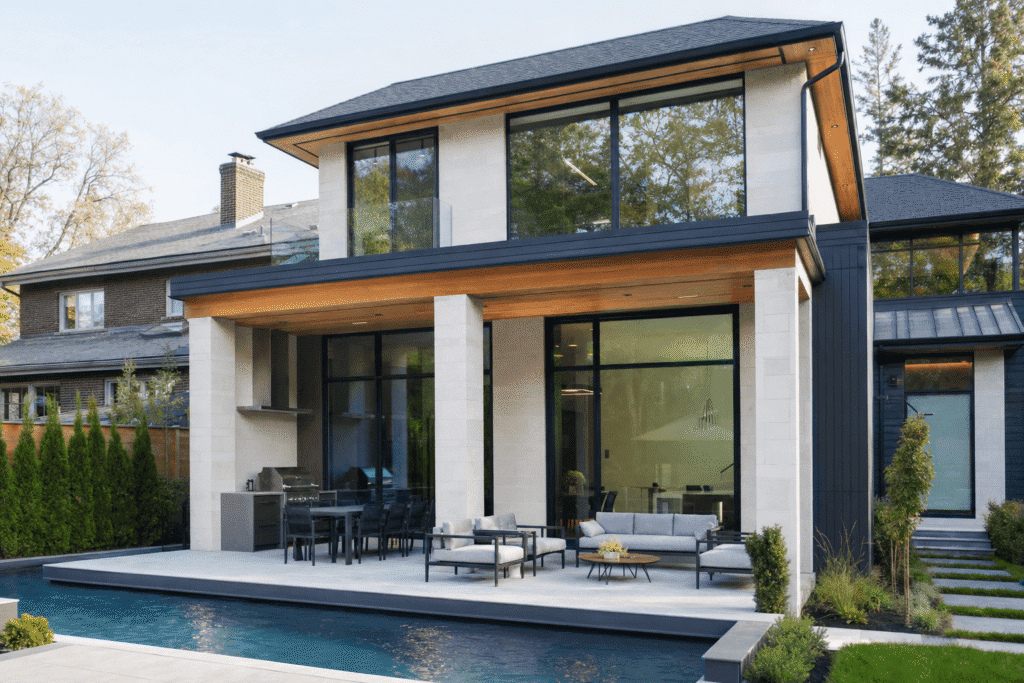
Most Toronto homeowners believe custom home construction starts at $500 per square foot. That’s a dangerous oversimplification. The reality involves land acquisition, municipal permits, Committee of Adjustment hearings, soft costs, and construction variables that can swing your budget by 40% or more. Understanding how much it costs to build a custom home in Toronto requires breaking down every phase from concept to occupancy, including the regulatory hurdles unique to Ontario’s largest city.
In 2026, building a custom home in Toronto isn’t just about square footage and finishes anymore. It’s about navigating HCRA registration, securing Tarion warranty coverage, managing lot severance approvals, and working within zoning bylaws that vary dramatically between North York, Etobicoke, and Scarborough. The total investment typically ranges from $600,000 for a modest build on a serviced lot to over $3 million for a luxury estate on a redeveloped property.
This guide breaks down the real numbers. You’ll understand what drives costs up or down, where budgets commonly blow out, and how to plan a realistic financial roadmap for your custom home project in the Greater Toronto Area.
Understanding the True Cost Components of Custom Home Construction
Custom home costs split into two distinct categories: hard costs and soft costs. Hard costs are the physical construction expenses. Soft costs are everything else, and they’re often underestimated by first-time builders.
Hard costs include foundation, framing, mechanical systems, exterior finishes, roofing, windows, doors, insulation, drywall, flooring, cabinetry, countertops, plumbing fixtures, electrical fixtures, and landscaping. In Toronto, these typically run $350 to $650 per square foot depending on specifications and complexity. A 2,500-square-foot home can range from $875,000 to $1,625,000 in hard costs alone.
Soft costs add another 15% to 30% on top. These include architectural design fees, structural engineering, permit applications, development charges, Committee of Adjustment submissions, HCRA registration, Tarion enrollment, legal fees, surveying, geotechnical reports, arborist reports, environmental assessments, financing costs, and builder overhead. For a $1 million build, soft costs can easily reach $200,000 to $300,000.
At Delvin Dream Homes, Dr. Faraz structures every project budget with a detailed line-item breakdown that separates hard and soft costs, so clients in North York and across Toronto understand exactly where their investment goes before breaking ground.
Land Acquisition and Site Preparation Costs in Toronto
You can’t build without land. Serviced residential lots in Toronto proper start around $800,000 in outer areas like Scarborough and easily exceed $2 million in central neighborhoods. North York lots near Yonge Street can command $1.5 million or more for a standard 50-foot frontage.
If you’re buying an existing property for demolition and rebuild, factor in demolition costs ($15,000 to $35,000), asbestos abatement if required ($5,000 to $20,000), and utility disconnection fees. Some builders overlook the cost of salvaging heritage elements or obtaining heritage permits, which can add months and tens of thousands to timelines in designated areas.
Site preparation varies wildly. A flat, serviced lot requires minimal grading and can be ready for construction in weeks. A sloped lot with poor drainage, mature tree preservation requirements, or rock excavation can add $50,000 to $150,000 before the first concrete pour. Geotechnical testing costs $2,000 to $5,000 but prevents expensive foundation surprises later.
Lot severance adds another layer of complexity and cost. If you’re splitting an existing lot to create two buildable parcels, the process through Toronto’s Committee of Adjustment involves application fees ($6,000+), legal costs ($10,000 to $20,000), surveying ($3,000 to $8,000), and often requires variance applications. For clients pursuing land development services in Toronto, we manage the entire severance process alongside architectural planning to maximize both lots’ buildable potential.
Design and Permit Costs for Custom Homes in Toronto
Architectural design fees for custom homes typically range from 8% to 15% of construction costs. For a $1.2 million build, expect $96,000 to $180,000 for comprehensive design services. This includes schematic design, design development, construction documents, permit drawings, and construction administration.
The cheapest route is purchasing stock plans online for $1,500 to $5,000. But stock plans don’t account for Toronto zoning bylaws, lot-specific setbacks, or your vision. They also require modification by a licensed architect anyway, often costing more in revisions than starting from scratch.
Building permit fees in Toronto are calculated based on construction value. A $1 million custom home incurs roughly $15,000 to $20,000 in permit fees. Development charges vary by ward and project type but can add another $30,000 to $60,000 for a single-family dwelling. These charges fund municipal infrastructure like water, sewer, roads, and parks.
Committee of Adjustment applications are necessary when your design requires variances from zoning bylaws, which happens on roughly 70% of Toronto custom home projects due to setback restrictions, lot coverage limits, or height constraints. Application fees start around $6,000, and legal representation adds $8,000 to $15,000. If neighbors oppose your application, expect delays and potentially higher costs for revisions or appeals.
At Delvin Dream Homes, we provide custom architectural design services that integrate Toronto zoning compliance from day one, reducing variance requirements and accelerating permit approvals across North York and the GTA.
Expert Tip from Delvin Dream Homes
We’ve seen clients save $40,000 by consolidating design and permitting under one licensed builder. When the architect understands HCRA requirements and Committee of Adjustment procedures, revisions drop by half and approvals come faster.
Construction Costs: Breaking Down Hard Costs Per Square Foot
Construction costs per square foot aren’t uniform across Toronto. They vary by home size, design complexity, finish level, and site conditions. Smaller homes cost more per square foot because fixed costs like HVAC systems, electrical panels, and kitchens don’t scale down proportionally.
A 1,500-square-foot bungalow might cost $500 per square foot ($750,000 total), while a 4,000-square-foot two-story home averages $425 per square foot ($1,700,000 total). Basement square footage is cheaper to finish than above-grade space, typically running $150 to $250 per square foot for a legal basement with separate entrance and egress windows.
Finish level dramatically impacts costs. Builder-grade finishes (laminate counters, vinyl flooring, standard cabinetry) land around $350 to $450 per square foot. Mid-range finishes (quartz counters, hardwood floors, semi-custom cabinets) push costs to $475 to $575 per square foot. Luxury finishes (marble, custom millwork, high-end appliances, smart home integration) easily exceed $650 per square foot.
Structural complexity adds cost too. A simple rectangular footprint is cheaper to build than an L-shaped or multi-gabled design. Vaulted ceilings, cantilevered upper floors, and extensive glazing increase labor and material expenses by 15% to 25%. Custom features like wine cellars, home theaters, or indoor pools require specialized trades and engineering.
For clients building 4-plex or garden suite projects, construction costs benefit from economies of scale. Four units on one lot share foundation, roofing, and utility infrastructure, reducing per-unit costs compared to four separate single-family builds.
HCRA Registration, Tarion Warranty, and Builder Insurance Costs
Since 2021, Ontario requires all home builders to register with the Home Construction Regulatory Authority (HCRA). This isn’t optional. If you’re acting as your own general contractor or hiring an unlicensed builder, you’re taking on significant legal and financial risk.
Licensed builders enrolled in HCRA pay annual licensing fees and must carry minimum liability insurance of $2 million. These costs get built into their pricing, typically adding 3% to 5% to total project costs. But the value is real: HCRA oversight ensures builders meet minimum standards, and disputes can be escalated to regulatory intervention.
Tarion warranty coverage is mandatory for new home construction in Ontario. It provides a seven-year structural warranty, two-year coverage on building envelope and electrical, plumbing, and HVAC systems, and one-year coverage on most other components. Tarion enrollment costs builders $750 to $1,500 per home plus a percentage of sale price (typically 0.45% to 0.65%).
Builder’s risk insurance protects the project during construction against fire, theft, vandalism, and weather damage. It costs roughly 1% to 2% of construction value. For a $1.2 million build, expect $12,000 to $24,000 in builder’s risk premiums. General liability insurance adds another $5,000 to $10,000 annually for most custom home builders.
Delvin Dream Homes is a licensed builder registered with HCRA and provides full Tarion warranty coverage on all new construction projects. Our team handles enrollment, inspections, and warranty documentation so clients in Toronto and across Ontario have complete protection from foundation to final occupancy.
DELVIN DREAM HOMES
Ready to build your dream home?
Get a free consultation with Dr. Faraz and our expert team to discuss your project vision, budget, and timeline.
How Location Within Toronto Affects Custom Home Building Costs
Building in downtown Toronto costs more than building in Scarborough or North York. Material delivery to congested sites adds $8,000 to $15,000 for crane time, traffic permits, and road closures. Parking permits for contractor vehicles cost $300 to $600 monthly in core areas.
Neighborhood character influences design requirements too. Heritage Conservation Districts like Cabbagetown or The Annex impose strict design guidelines that increase architectural fees and require heritage permits ($3,000 to $8,000). Custom millwork and period-appropriate details can add 10% to 20% to construction costs compared to a contemporary build in a newer subdivision.
Utility connections vary by area. Older neighborhoods may require costly upgrades to electrical service, water mains, or sewer laterals. Connecting to municipal water and sewer typically costs $5,000 to $15,000, but older infrastructure can double that. Some North York properties near the hydro corridor face higher electrical connection fees due to distance from transformers.
Soil conditions differ across Toronto. Areas near the Don Valley or Humber River often have high water tables requiring more expensive foundation drainage systems and sump pumps. Rocky terrain in parts of North York and Etobicoke adds $20,000 to $60,000 for rock excavation and disposal.
Property taxes during construction are often overlooked. If your build takes 18 months, you’re paying property taxes on the land the entire time. For a $1.5 million assessed lot, that’s roughly $20,000 to $25,000 in taxes before you move in.
Expert Tip from Delvin Dream Homes
In North York, we’ve completed over 30 custom homes where soil testing revealed high clay content. Proper foundation design added $15,000 upfront but prevented $80,000 in foundation repairs that neighboring properties faced three years post-construction.
Timeline Impact on Costs: Carrying Costs and Inflation
Construction timelines directly affect total project costs through carrying costs and inflation. A typical custom home in Toronto takes 12 to 18 months from permit approval to occupancy. If permits face delays through Committee of Adjustment appeals or revisions, add another 6 to 12 months.
Carrying costs include construction financing interest, property taxes, and insurance. If you borrow $1 million at 7% interest over 18 months, you’ll pay roughly $105,000 in interest alone. Property taxes and insurance add another $25,000 to $35,000 during that period. These costs exist whether construction progresses smoothly or faces delays.
Material cost inflation in 2026 continues to affect budgets. Lumber, steel, concrete, and copper prices fluctuate based on global supply chains. A project quoted in January may face 5% to 8% material cost increases if construction doesn’t start until September. Fixed-price contracts protect against this, but most builders include escalation clauses for projects longer than 12 months.
Labor shortages in the GTA also drive costs up. Skilled trades like plumbers, electricians, and HVAC technicians are in high demand. Rush fees to secure trades on your timeline can add 10% to 15% to labor costs compared to flexible scheduling. Winter construction slows progress and increases heating costs for enclosed spaces during finishing work.
Fast-tracking permits and approvals saves carrying costs. Working with an experienced architect and builder who understands Toronto’s Building Department procedures can shave 2 to 4 months off the approval timeline, saving $15,000 to $30,000 in carrying costs.
Additional Dwelling Units and Multiplex Cost Considerations
Ontario’s Bill 23 and Toronto’s multiplex housing reforms make building additional dwelling units and 4-plex buildings more viable than ever. Adding a legal second suite or garden suite increases construction costs but also increases property value and rental income potential.
A legal basement apartment adds $60,000 to $120,000 to construction costs depending on finish level and existing conditions. This includes separate entrance construction, egress windows, fire separation assemblies, independent mechanical systems, and permit fees. Monthly rental income in Toronto ranges from $1,800 to $2,800, providing 12% to 20% annual return on the suite investment.
Garden suites (detached accessory dwelling units) cost $200,000 to $400,000 to build depending on size and finishes. A 600-square-foot garden suite runs roughly $330 to $500 per square foot all-in. Permit fees are lower than for primary dwellings, but utility connections, foundation work, and separate mechanical systems still apply.
4-plex construction on a single lot costs more upfront than a single-family home but delivers four rentable units. Total construction costs typically range from $1.8 million to $3.2 million for a full 4-plex build. Per-unit costs drop to $450,000 to $800,000, making it more economical than building four separate homes.
Zoning for multiplex housing is expanding across Toronto, but lot size and frontage requirements still apply. Most 4-plex projects require Committee of Adjustment variances for setbacks or density. Dr. Faraz and the team at Delvin Dream Homes have successfully navigated dozens of multiplex approvals, balancing maximum unit count with neighborhood compatibility and zoning compliance.
Key Takeaways
- Budget $600 to $900 per square foot including land, permits, and construction.
- Expect soft costs to add 15% to 30% beyond hard construction expenses.
- Verify your builder is HCRA-licensed and provides Tarion warranty coverage.
- Choose serviced lots over raw land to avoid $50,000+ in site preparation.
- Plan 12 to 18 months from permit to occupancy, factoring carrying costs.
Frequently Asked Questions
Plan Your Custom Home Budget With Expert Guidance
Building a custom home in Toronto requires balancing architectural vision with municipal regulations, construction realities, and financial constraints. The difference between a successful project and a budget disaster often comes down to working with a licensed builder who understands Toronto zoning, manages permit processes efficiently, and delivers transparent pricing from concept through completion.
Delvin Dream Homes brings end-to-end service to custom home projects across North York, Toronto, and Ontario. Dr. Faraz and our team handle design, permits, construction, and warranty enrollment under one roof, eliminating coordination gaps and cost overruns. Ready to explore your custom home vision with realistic budgeting and expert execution? Get a free quote and consultation to discuss your project goals, site requirements, and financial planning today.
