
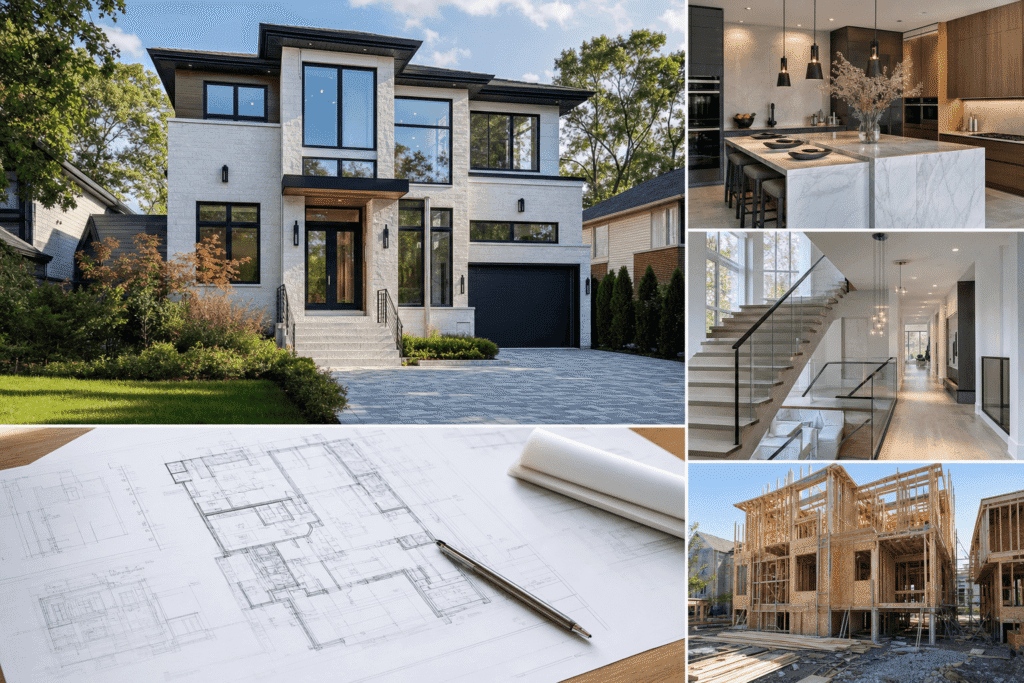
Most Toronto developers assume any multiplex qualifies for CMHC MLI Select financing. Wrong. The Canada Mortgage and Housing Corporation sets strict minimum unit requirements that catch many first-time builders off guard. Your fourplex might look perfect on paper, but if it doesn’t meet the specific thresholds for unit count, accessibility, and affordability criteria, your application gets rejected before anyone even reviews your architectural drawings.
Understanding whether your project is eligible for CMHC MLI Select comes down to knowing the minimum unit requirements and how they interact with Toronto zoning bylaws. At Delvin Dream Homes, Dr. Faraz and our design team work directly with developers and property owners across North York and the Greater Toronto Area to align multiplex housing design with CMHC program criteria from the earliest conceptual stages.
The MLI Select program exists to encourage purpose-built rental housing. But eligibility isn’t automatic. You need the right unit count, the right mix of unit types, compliance with accessibility standards, and a commitment to long-term affordability. This guide explains exactly what your project needs to qualify, how the minimum unit requirements work in practice, and what to verify before you invest in detailed design or construction planning.
What Is CMHC MLI Select and Why Unit Count Matters
CMHC MLI Select stands for Multi-Unit Residential Loan Insurance Select. It’s a mortgage loan insurance product designed specifically for developers building or acquiring purpose-built rental housing. The program offers competitive interest rates and flexible underwriting, making it easier to finance multi-unit projects that meet CMHC’s affordability and accessibility criteria.
Unit count matters because the program applies only to projects with a minimum number of residential units. CMHC sets this threshold to focus support on developments that contribute meaningfully to rental housing supply, not scattered conversions or small-scale projects that don’t move the needle on housing availability.
In most cases, the minimum unit requirement for CMHC MLI Select is five residential rental units. That’s the baseline. Your project must deliver at least five self-contained rental units to even be considered. A duplex doesn’t qualify. A triplex doesn’t qualify. A standard fourplex falls short by one unit.
This threshold shifts the playing field. Many Toronto property owners explore duplexes, triplexes, or fourplexes under the city’s multiplex zoning reforms. Those projects can work well for ownership or smaller-scale rental income. But if you’re planning to leverage CMHC MLI Select financing, you need to design for at least five units from day one.
CMHC MLI Select Minimum Unit Threshold: Five Units or More
The five-unit minimum isn’t negotiable. CMHC won’t process applications for buildings with fewer units. This creates a decision point early in the design process. If you’re working with a lot that can’t accommodate five units under Toronto zoning bylaws, MLI Select isn’t an option.
At Delvin Dream Homes, we start every land development consultation by evaluating the maximum number of units the lot can support based on zoning, lot coverage, height restrictions, and parking requirements. Dr. Faraz reviews site dimensions, setbacks, and density permissions before we recommend a unit count. If the goal is MLI Select eligibility, we design for five units minimum, often pushing for six or more where zoning allows.
Five units typically means a low-rise building: a walk-up, a stacked townhouse configuration, or a small apartment block. In North York and across Toronto, you’ll find these configurations on larger residential lots, infill sites, or properties rezoned for higher density under the city’s multiplex and missing middle housing initiatives.
Some projects exceed the five-unit threshold easily. A six-unit building gives you more flexibility in unit mix. Eight units can improve project economics. Twelve units start to shift financing into different CMHC programs with additional requirements. But five is the floor. Anything less disqualifies your project immediately.
Expert Tip from Delvin Dream Homes
We often see developers design a fourplex and later realize they need five units for CMHC financing. At that point, redesigning costs time and money. Start with financing strategy before finalizing your unit count.
Unit Type and Accessibility Requirements Under MLI Select
Meeting the five-unit minimum is necessary but not sufficient. CMHC MLI Select also imposes requirements on unit types, accessibility features, and building design standards. These criteria ensure that the housing you build serves a broad range of renters, including families, seniors, and people with disabilities.
Every project must include at least one accessible unit designed to meet or exceed applicable accessibility standards. In Ontario, that usually means compliance with the Ontario Building Code accessibility provisions, plus any additional municipal requirements. Accessible units require barrier-free access from the building entrance, wider doorways, accessible washrooms, and clear circulation space.
For buildings with five to nine units, one accessible unit typically satisfies the requirement. As unit count increases, so does the number of accessible units required. These thresholds are cumulative and nonnegotiable. If your design doesn’t include the required accessible units, CMHC rejects the application.
Unit mix also matters. CMHC favors projects that include a variety of unit sizes: bachelor, one-bedroom, two-bedroom, and three-bedroom units. A building with all bachelor units faces more scrutiny than a building with a balanced mix that can accommodate singles, couples, and families. The program prioritizes rental housing that serves diverse household types, especially families with children.
At Delvin Dream Homes, Dr. Faraz integrates accessibility planning into the initial design phase. We locate accessible units on the ground floor or elevator-accessible levels, design barrier-free pathways from parking and entrances, and ensure washroom layouts meet dimensional and fixture requirements. This isn’t an afterthought. It’s part of the core design strategy for multiplex housing projects across Toronto and Ontario.
DELVIN DREAM HOMES
Ready to build your dream home?
Get a free consultation with Dr. Faraz and our expert team to discuss your project vision, budget, and timeline.
Affordability Criteria and Rental Commitment Under CMHC MLI Select
CMHC MLI Select isn’t just about building units. It’s about building affordable rental housing. The program requires a minimum percentage of units to be rented at or below 30% of median household income thresholds. This affordability commitment typically lasts for at least ten years, with specific percentages varying by location and program stream.
In practice, this means you can’t charge market rents on every unit and still qualify. A portion of your units must be reserved for lower-income renters, with rents capped based on CMHC’s area median income data. The exact percentage depends on whether you’re applying under the standard MLI Select criteria or a specific affordability stream.
For many developers, this affordability requirement changes the pro forma. You need to model rental income with some units at below-market rates and ensure the project still generates positive cash flow. That’s where unit count becomes critical. A building with only five units has less flexibility to absorb below-market rents than a building with eight or ten units.
The rental commitment is binding. You can’t convert the building to condominiums during the affordability period. You can’t sell individual units. The building remains as rental housing for the duration of the commitment. CMHC monitors compliance, and violations can trigger penalties or loss of insurance.
At Delvin Dream Homes, we help clients model these requirements during feasibility analysis. Dr. Faraz and our team work with financial advisors and mortgage brokers who specialize in CMHC programs to ensure the unit mix, rent targets, and project budget align with MLI Select criteria before we finalize architectural drawings.
Expert Tip from Delvin Dream Homes
Many Toronto developers underestimate the long-term rental commitment. We always recommend running cash flow projections with below-market units included before committing to MLI Select financing. It’s not the right fit for every project.
How Toronto Zoning Affects Your Ability to Meet Minimum Unit Requirements
Your lot’s zoning determines whether you can build five or more units. Toronto’s zoning bylaws set maximum density, lot coverage, building height, and unit count for every property. Even under the city’s multiplex reforms, not every lot can accommodate five units.
Zoning in Toronto typically uses density metrics like floor space index (FSI) or units per hectare. A lot zoned for low-density residential might allow only two or three units. A lot in a residential apartment zone might allow ten or more. If your zoning caps unit count at four, you’ll need a minor variance or rezoning to reach the five-unit threshold for CMHC MLI Select.
Dr. Faraz regularly navigates these zoning challenges through Toronto’s Committee of Adjustment process. When a client’s property falls one or two units short of the MLI Select minimum, we prepare variance applications to increase the permitted unit count, often by demonstrating that the building maintains appropriate setbacks, parking, and compatibility with the neighborhood.
Parking requirements also constrain unit count. Toronto requires a certain number of parking spaces per unit, and if your lot can’t fit the required parking, you can’t add more units. Some multiplex projects qualify for parking reductions near transit, but you need to verify this early in the planning process.
Lot size matters too. A narrow urban infill lot might physically accommodate only three or four units even if zoning technically allows more. Setback requirements, building separation distances, and outdoor amenity space all reduce the buildable area. At Delvin Dream Homes, we conduct detailed site analysis and prepare preliminary massing studies to confirm the site can support the target unit count before clients commit to a CMHC MLI Select financing strategy.
Additional Eligibility Criteria Beyond Unit Count
Meeting the five-unit minimum and accessibility requirements doesn’t guarantee approval. CMHC MLI Select has additional eligibility criteria that affect whether your project qualifies.
First, the building must be purpose-built rental housing. You can’t apply MLI Select financing to condominium projects, even if you plan to hold the units as rental investments. The legal structure must designate the building as rental from the start.
Second, the borrower must have experience or capacity to manage rental housing. CMHC evaluates the developer’s track record, financial strength, and property management plan. First-time developers may face additional scrutiny or requirements to partner with experienced operators.
Third, the project must meet energy efficiency standards. CMHC encourages or requires participation in programs like ENERGY STAR or equivalent certifications. Buildings that exceed minimum code requirements for energy performance score better in the underwriting process.
Fourth, the project must demonstrate financial viability. CMHC reviews construction budgets, rental income projections, operating expense estimates, and debt service coverage ratios. If the numbers don’t work, the application gets rejected regardless of unit count or accessibility features.
Finally, the project must align with local housing priorities. CMHC coordinates with provincial and municipal housing strategies. Projects that contribute to identified housing needs, such as family-sized units or housing near transit, receive more favorable consideration.
These layered requirements mean that eligibility isn’t binary. A project can meet the five-unit minimum but still fail to qualify if it doesn’t satisfy affordability commitments, accessibility standards, or financial viability tests. At Delvin Dream Homes, we treat CMHC MLI Select eligibility as a design constraint from day one, integrating program requirements into site selection, unit mix planning, and construction budgeting.
How to Verify Your Project’s Eligibility Before You Start Design
Don’t design first and check eligibility later. The smarter approach is to verify CMHC MLI Select eligibility during the feasibility stage, before you invest in detailed architectural drawings, engineering, or permit applications.
Start by reviewing your lot’s zoning. Confirm the maximum number of units allowed by right. If the zoning permits fewer than five units, explore whether a minor variance or rezoning is realistic. In Toronto, variance applications through the Committee of Adjustment take three to six months. Rezoning can take a year or more. Factor that timeline into your project schedule.
Next, assess the lot’s physical capacity. Can it fit five units while meeting setback, parking, and outdoor amenity requirements? Dr. Faraz often sketches preliminary site plans to verify buildable area before clients commit to land purchases. A lot that looks promising on paper might not deliver the required unit count once you apply all zoning constraints.
Then, model the project’s financials with CMHC MLI Select assumptions. Include the affordability requirement. Assume a percentage of units will rent at below-market rates. Calculate debt service coverage with those rents. If the numbers work, the project is financially viable. If not, you need to adjust the unit mix, reduce construction costs, or explore alternative financing.
Consult with a mortgage broker who specializes in CMHC programs. They can pre-screen your project concept, identify red flags, and confirm whether your unit count, accessibility features, and affordability commitments align with current MLI Select criteria. Program rules evolve, and brokers stay current with the latest requirements.
Finally, engage an architect or designer experienced with CMHC-financed projects. At Delvin Dream Homes, we’ve worked with multiple developers pursuing MLI Select financing. We know how to design for accessibility, optimize unit mix, and document compliance in a way that streamlines CMHC’s underwriting process. That experience saves time and reduces the risk of costly redesigns later.
Key Takeaways
- Verify your lot’s zoning allows five or more units before pursuing MLI Select.
- Include at least one accessible unit designed to Ontario Building Code standards early.
- Model project cash flow with below-market rents to test financial viability upfront.
- Confirm parking and setback requirements won’t block your target unit count physically.
- Engage a CMHC-experienced architect during feasibility, not after land purchase or design.
Frequently Asked Questions
Understanding CMHC MLI Select minimum unit requirements isn’t optional if you’re serious about securing financing for a rental housing project. The five-unit threshold, accessibility standards, affordability commitments, and zoning constraints all interact to determine whether your project qualifies. Getting these details right during the planning stage saves you from expensive redesigns, permit delays, or rejected financing applications later.
If you’re exploring a multiplex or multi-unit rental project in Toronto or across Ontario, start with a consultation that aligns your site, your budget, and your financing strategy. Get a free quote from Delvin Dream Homes and work with Dr. Faraz and our experienced design and construction team to build a project that meets CMHC MLI Select criteria from concept to completion.
