
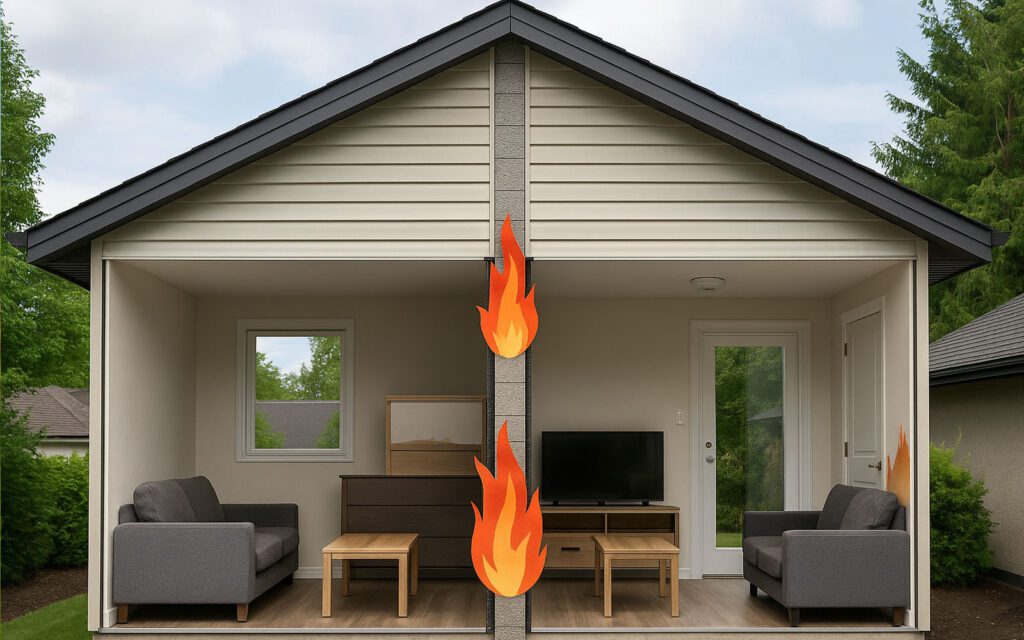
Adding a Secondary Suite (also called a basement apartment or accessory dwelling unit) in Toronto triggers specific requirements under the Ontario Building Code (OBC). One of the most critical safety measures is ensuring proper fire separation between the main dwelling and the secondary suite.
Why Fire Separation Matters
- Prevents the rapid spread of fire and smoke between units.
- Provides adequate time for safe egress during emergencies.
- Required for compliance with Toronto Building Division inspections.
General OBC Requirements
According to OBC Part 9 (Housing and Small Buildings), Sections 9.10.9 and 9.10.10:
- Between the Primary Dwelling and the Secondary Suite
- A minimum 30-minute fire-resistance rating (FRR) is required for separating walls, floors, or ceilings.
- If There Is a Shared Exit or Egress Path
- For example, if the secondary suite occupants must pass through a shared stair or corridor:
- A 45-minute FRR separation is required between the suite and that shared egress.
- Doors Between Units
- Any communicating door must be a fire-rated door with a minimum 20-minute rating, equipped with a self-closing device.
- Penetrations for Mechanical or Electrical Systems
- Ducts, pipes, and conduits passing through fire separations must be protected with fire stopping and, where required, fire dampers.
New vs. Existing Buildings
1. New Buildings (Post-1994, under Current OBC)
- Must meet full fire separation requirements (30 or 45 minutes as noted).
- Fire separations must use tested and listed assemblies (e.g., Type X gypsum, concrete slabs).
- Interconnected smoke alarms are mandatory in both units.
- Typically, a dedicated exit is required for the secondary suite.
2. Existing Buildings (Pre-1994, governed under OBC Part 11 – Renovation)
- The OBC provides flexibility through Alternative Compliance provisions.
- Where achieving full fire separations is impractical, owners may use:
- Independent sprinklers in the secondary suite,
- Interconnected smoke/CO alarms between units,
- Limited upgrades such as adding a single layer of Type X gypsum board to existing assemblies.
- This approach allows older houses to achieve acceptable safety levels without full reconstruction.
Typical Fire Separation Assemblies
- Common Wall: Double 1/2″ gypsum board each side of 2×4 studs with mineral wool insulation = 30 min FRR.
- Floor/Ceiling Between Units: Two layers of 1/2″ Type X gypsum under joists with mineral wool = 45 min FRR.
- Shared Stairwell: Gypsum-protected partitions with 20-minute rated door + self-closer.
Key Toronto Inspection Priorities
Municipal examiners and inspectors focus heavily on:
- Interconnected smoke and CO alarms (hardwired or wireless, must sound in both units).
- Safe and independent egress (exit door or conforming egress window).
- Fire separation integrity at all penetrations (plumbing, HVAC).
- Compliance with minimum window size for emergency egress (as per OBC 9.9.10).
Smoke Alarms
- City inspectors often fail inspections if the alarms are not interconnected across both units — this is the #1 item they check.
- Wireless interconnected alarms (CSA/ULC approved) are widely accepted by Toronto Building for older homes where wiring is difficult.
- Both units must have audible alarms loud enough to wake sleeping occupants (OBC 9.10.19.2).
Summary
- New construction: Full fire separations required (30–45 minutes).
- Existing houses: May use alternative compliance (sprinklers, alarms, limited upgrades) under OBC Part 11.
- Doors: Minimum 20-minute fire-rated, self-closing.
- Egress: Must always provide safe, code-compliant exits.
References
- Ontario Building Code 2012/2022 (Consolidated Edition):
- Division B, 9.10.9.14 – Fire Separations Between Dwelling Units
- Division B, 9.10.9.15 – Fire Separations for Exits
- Division B, 9.10.10 – Ratings of Fire Separations
- Division B, 11.3 – Compliance Alternatives for Renovation
- City of Toronto – Secondary Suites Information
